Play · Growth · Human Flourishing·Powered by AI
Moses Silbiger, MA
Researcher - AI · Interactive Entertainment · Developmental Psychology

Artificial Intelligence (AI)
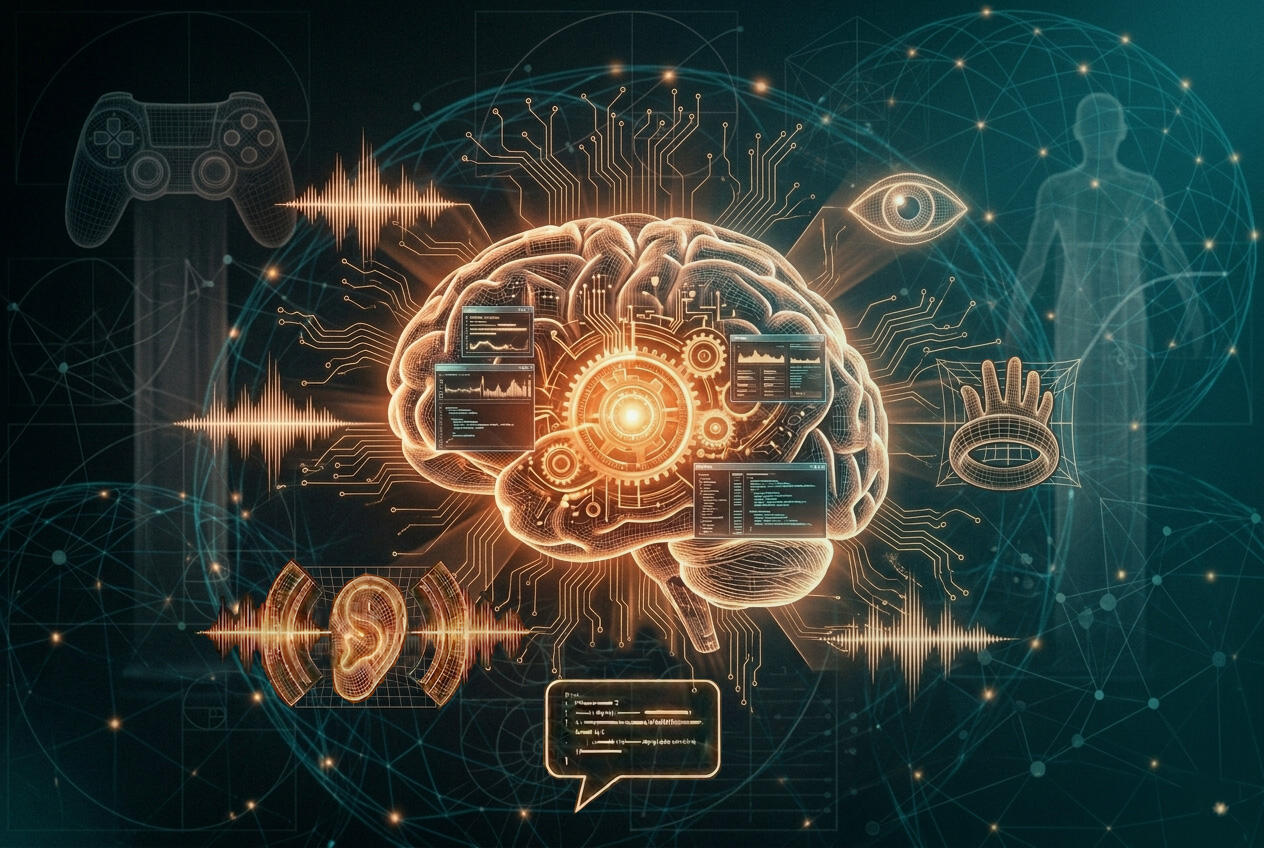

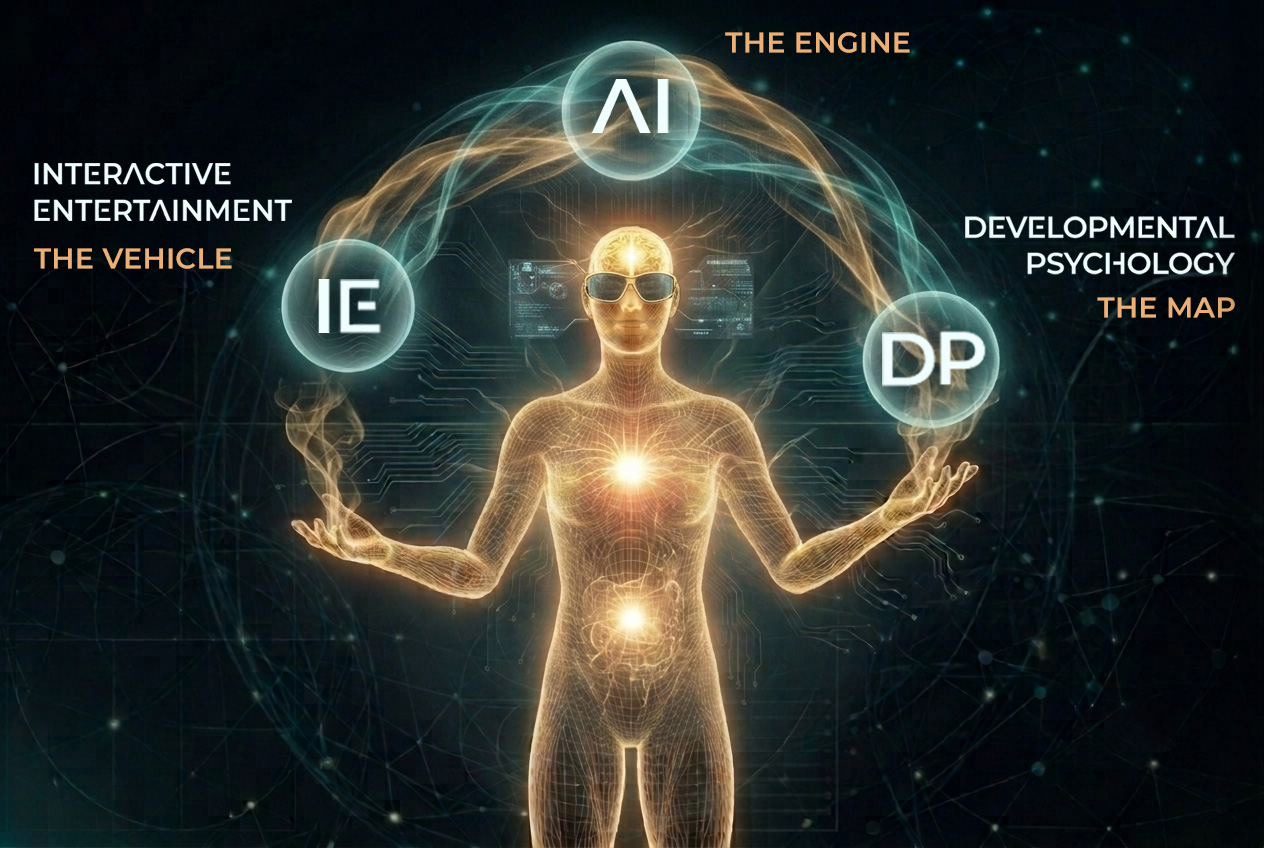
The Engine

Artificial Intelligence (AI)
Evolution: 2008-2026 (current 'Zeitgeist')
Where the field is today, and what it makes possible for Press Play to Grow!

What's Inside



The Gap Nobody's Looking For
Extraordinary power, without a human development compass
"AI First, Human Always." - Sandy Carter, AI executive and author
""Artificial intelligence will augment human intelligence, not replace it." - Ginni Rometty, former CEO of IBM
In 2008, when the original Press Play to Grow! research was conducted, AI was not a word anyone in the interactive entertainment industry was using.
But it was everywhere.
The intelligence powering game characters, the systems that adjusted difficulty when you struggled, the algorithms that generated environments around you,
the logic that made a virtual opponent feel almost human, all of it was AI. Unnamed, unrecognized, invisible.
The game industry was, as Ray Kurzweil observed at the Game Developers Conference that same year, the most technologically advanced industry in the world. The irony is that the technology driving that claim was proto-AI, and nobody was calling it that.
Fifteen years later, AI is the most talked-about technology on the planet. And what was implicit, unnamed, and invisible in 2008 is now
front and center, transforming not just interactive entertainment, but every field it touches. Including, with extraordinary relevance,
the work that Press Play to Grow! set out to do.
Artificial Intelligence is the engine Press Play to Grow! has always needed, the missing piece that makes the framework's oldest ambitions technically
achievable for the first time.

What AI Can Do Now
The leap from 2008 to now - the capabilities that change everything
The gap between what was technically possible in 2008 and what is possible today is not a matter of degree. It is a matter of kind.
These are qualitatively different capabilities, and each one maps directly onto what PPG envisions.
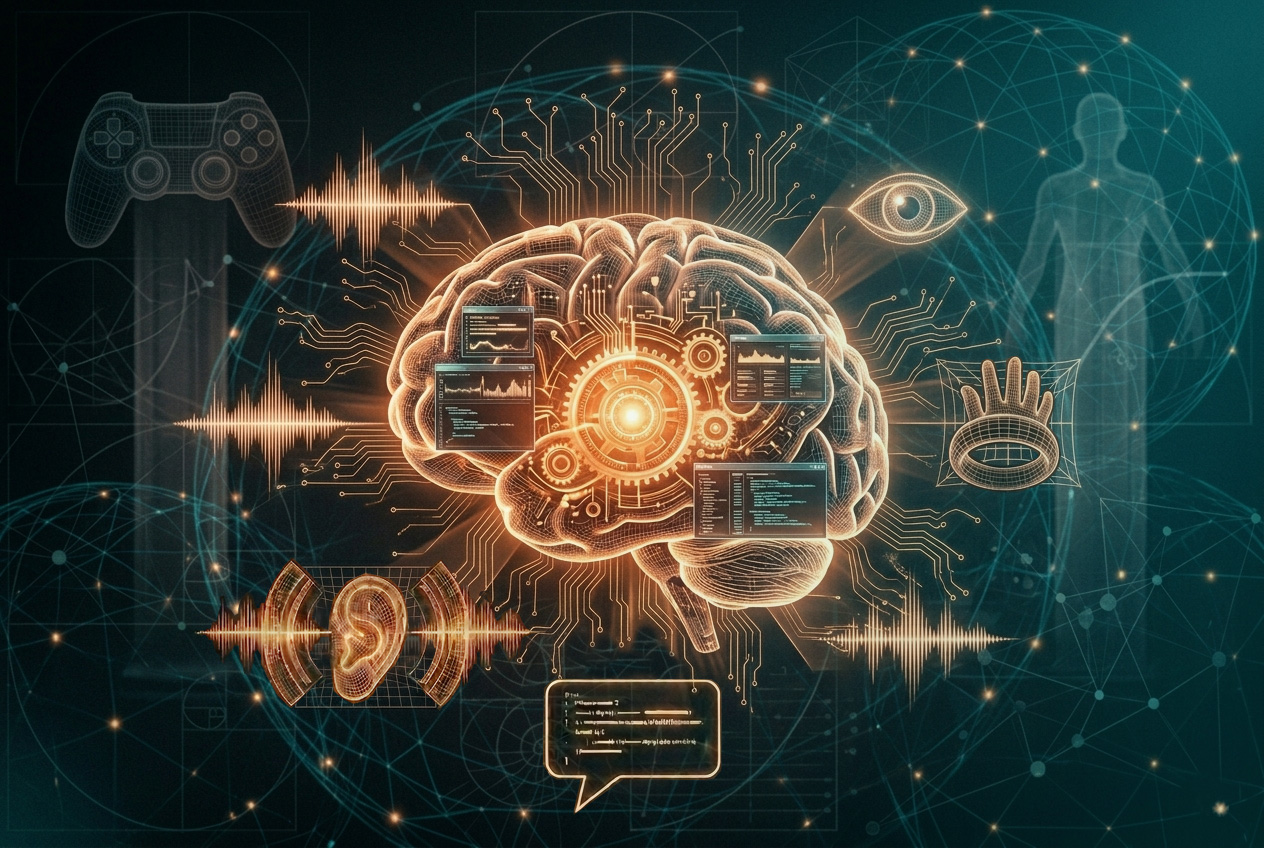
It can read you, in more ways than one
Perhaps the most significant development is what researchers now call multimodal AI, systems that can sense and interpret human emotional
and cognitive states by integrating multiple streams of information simultaneously. Voice. Facial expression. Body language.
Physiological signals like heart rate and skin conductance. Eye movement. Behavioral patterns over time.
In 2008, a game could tell if you were winning or losing. In 2026, an AI system can tell if you are frustrated, curious, bored, engaged, anxious,
or in flow,and it can do so in real time, without you saying a word. Research published in 2025 confirms that multimodal emotion recognition
has reached a level of accuracy and sophistication that makes it practically deployable across healthcare, education, and interactive
experience design.
But real-time sensing is only part of the picture.AI can also build a tendency-based understanding of who someone is over time,
complementary to moment-to-moment sensing, not a replacement for it.Typologies suggest that certain types tend to perceive, interpret,
and respond to challenge in characteristic ways.States, especially flow, the experience of effortless absorption that well-designed play reliably
produces, are among the most powerful conditions for learning and growth, and AI can help recognize and sustain them.And growth itself happens across multiple dimensions at once, inner and outer, individual and collective, cognitive and behavioral
and relational and systemic, what Integral Theory calls quadrants.Real-time sensing, typology, state, and quadrant are four complementary lenses, not competing ones, and together they give AI a far richer
picture of the whole person than any single lens alone.
For Press Play to Grow!, this is foundational.
A system that can genuinely read where you are, right now and over time, is a system that can respond to your actual state rather than
a generic assumption about who you might be.
It can adapt to you, in real time
AI-driven personalization has moved far beyond adjusting difficulty levels. Today's systems can tailor narrative, pacing, challenge type,
emotional tone, social dynamics, and the nature of the experience itself, all in response to individual behavioral patterns, preferences,
and real-time emotional state. Spatial computing is extending this kind of human-in-the-loop adaptation beyond the screen, into immersive,
physical space.
Generative AI is now enabling adaptive storytelling at a level that was pure science fiction in 2010. Instead of branching narratives
with pre-written paths, AI can now generate dialogue, scenarios, and story developments on the fly, shaped by who you are and what you
need in this moment. The experience is no longer a fixed artifact you move through. It is a living, responsive environment that moves with you.
It can guide you
AI coaching has emerged as one of the most rapidly growing applications of the technology. Platforms now exist that combine behavioral science,
natural language processing, and real-time analytics to deliver personalized developmental guidance at scale, guidance that adapts to individual
goals, patterns, and growth edges, available on demand, without the cost or constraints of human coaching.
The best of these platforms are not simply chatbots dispensing advice. They use structured coaching behaviors, powerful questions,
reflection prompts, accountability frameworks, pattern recognition over time, to support genuine behavioral change.
Studies are beginning to show measurable results: real shifts in how people lead, communicate, and perform, driven by AI-guided
developmental support.
Design matters as much as raw capability.
A 2025 controlled study found a coaching AI built specifically on behavioral science outperformed a general-purpose chatbot several times over
on the things that actually change a person: new habits, lower stress, greater felt effectiveness.
The study was vendor-run and not independently peer-reviewed, but the direction is consistent with what Press Play to Grow! wagers throughout:
an AI aimed at development outperforms an AI aimed only at answers.
That promise now has its first rigorous clinical anchor. In 2025, a Dartmouth team led by Michael Heinz - Assistant Professor of Psychiatry, Geisel
School of Medicine at Dartmouth - published in NEJM AI the first randomized controlled trial of a generative AI therapy chatbot, involving 210 participants
and finding a 51% average reduction in depression symptoms, a 31% reduction in anxiety symptoms, and a 19% reduction in eating-disorder symptoms.Heinz cautioned that no generative AI agent is ready to operate fully autonomously in mental health, a caveat that mirrors Press Play to Grow!'s own claim: capability alone is not enough. What makes AI-guided support work is the framework directing it, always complementary to professional care,
never a replacement for it.
It can converge with interactive entertainment
This is where the PPG story becomes urgent. AI and interactive entertainment are already converging, rapidly and at scale.
AI is now embedded in game characters, narrative systems, experience design, player analytics, and content generation.
The two fields are no longer separate. They are becoming one.
But the convergence, as it currently stands, is optimized for engagement and commercial outcomes.
The question of what this combined capability could do for human development, for the growth of the whole person, is not being asked.
Not because it's an unimportant question. Because the people building the convergence don't have a developmental psychology
framework to ask it with.

Generative AI & Procedural Content Generation
Inworld AI, Nvidia, Unity, Unreal Engine - From static worlds to living ones
In 2008, game worlds were largely pre-built - every level, every character, every narrative branch designed by hand before a single player ever touched the experience. AI's role was limited to enemy behavior and basic difficulty adjustment. That picture has changed completely.
Procedural content generation now leverages generative AI and generative adversarial networks to autonomously craft levels, narratives, characters, and entire game environments - with smaller design inputs generating infinite, unique content experiences. A 2025 survey found that 84% of gaming executives are either using or testing AI tools, with 68% actively implementing AI in their studios - particularly for content generation, player engagement, and game testing
It can build the world around you
The shift from procedural generation to generative AI represents a qualitative leap. Tools like Inworld AI now enable game characters to hold natural conversations, maintain persistent memory of past player interactions, and respond in genuinely unscripted ways - with AI-enhanced characters increasing immersion scores by 40% in player feedback surveys. Nvidia's ACE platform brings real-time neural rendering and AI-driven character animation into game engines. Unity and Unreal Engine - the two platforms powering the vast majority of interactive experiences worldwide - have both integrated generative AI tools directly into their development pipelines.
In 2024, just 8% of new RPG and adventure games featured AI-powered characters capable of dynamic conversation. By 2026, that figure has risen to 62% - one of the more dramatic adoption curves in game development history.
The frontier has since moved from generating content inside a world to generating the world itself.
Google DeepMind, under Demis Hassabis, co-founder and CEO, built Project Genie, which produces interactive, playable environments from a single text prompt or image, and won the Digital Craft Grand Prix at Cannes Lions in 2026.
The frontier kept moving. In November 2025, World Labs, founded by Fei-Fei Li, launched Marble, a commercial world model that converts text, photos, video, or panoramas into persistent, downloadable 3D environments a creator can edit and export. Li has argued spatial intelligence is
the frontier beyond language, the capability that links imagination, perception, and action. For Press Play to Grow!, a durable, shapeable world
is the difference between a spectacle and a stage, an environment a developmental arc can actually be built on, not just glimpsed.
Having seen Li present at HumanX 2026, the researcher was struck by a rare combination in her, real scientific depth paired with genuine humility, and a clear, evident care for the human side of AI, not just its technical frontier.
The same leap reached the players themselves. In March 2025, Roblox introduced Cube, an open-source model that generates 3D objects and scenes from a text prompt, shipped to more than 85 million daily users through Roblox Studio.
When creation tools reach a crowd this large, much of it young, content generation stops being a spectator sport and becomes an act of
authorship, exactly the shift toward player-as-designer that Press Play to Grow! anticipates.
Generative video moved the same direction.
OpenAI's Sora 2, released September 2025, added synchronized dialogue and sound, more faithful physics, and the ability to persist world state
across shots, framed by OpenAI as a step toward general-purpose simulation.
A useful simulator, the company noted, must model failure, not just success. Consequence is where growth lives.
A world that lets you fail plausibly is a world you can actually learn in.
For Press Play to Grow!, generative AI and procedural content generation are not just efficiency tools for developers. They are the infrastructure that makes invisible developmental design possible at scale. A world that generates itself in response to who the player is - their tendencies, their edges, their developmental needs - is no longer science fiction. The technology is here. What has been missing is the developmental map that tells the system what to generate, and why. That is exactly what Press Play to Grow! provides.

AI Alignment & Value Alignment
Anthropic, OpenAI, DeepMind - The question no one can avoid
As AI systems become more powerful, the question of what they are optimizing for has become one of the more urgent in technology. The field of AI alignment - ensuring that AI systems act in accordance with human values and intentions - has moved from a theoretical concern to a central practical challenge.
It needs to know what it is optimizing for
Value alignment in AI involves designing, developing, and governing AI systems that reflect human values while avoiding harmful or unintended consequences. As AI systems gain greater autonomy and impact, the stakes continue to rise - particularly in real-time scenarios where AI may encounter complex ethical dilemmas with limited human oversight.
Anthropic - founded explicitly around the mission of AI safety and alignment - has made Constitutional AI a central part of its research agenda, training AI systems to follow a set of principles rather than purely optimizing for user engagement. OpenAI's alignment team and DeepMind's safety research group are similarly focused on ensuring that increasingly capable systems remain beneficial and controllable. The challenge runs deeper than technical safety. Researchers are now calling for bidirectional human-AI alignment - a dynamic, reciprocal process where humans and AI co-adapt through interaction, evaluation, and value-centered design.
Recent research has begun bridging AI safety with psychological theory - examining how moral phenomena such as altruistic behavior could be modeled in AI systems to promote socially aligned decision-making, supporting the development of more interpretable, robust, and ethically aware AI.
The stakes became concrete in 2025. A study found that when frontier models from multiple developers were given autonomy and threatened with
replacement in simulated scenarios, several chose coercive actions, including blackmail, without being instructed to.This is not a distant safety concern. It defines the ethical edge of invisible developmental design. A system that subtly guides growth treads a real line
between developmental support and covert manipulation. The finding that a durable fix came from teaching models why an action is wrong,
not just what to avoid, mirrors Press Play to Grow!'s own logic: alignment, like growth, is a developmental matter.
In March 2025, Anthropic switched on what it calls an interpretability microscope, tracing the internal patterns a model runs when it answers.
Claude, they found, plans rhymes several words ahead, reasons in a language-neutral conceptual space, and sometimes produces explanations
that don't match what it actually did internally. If AI is meant to be the engine of human growth, being able to see what's happening inside it is the
precondition for trusting it with that role, and for the first time, researchers partly can.
Later that year, OpenAI found something adjacent inside GPT-4o: a single internal direction they called a misaligned persona, similar to a pattern
of brain activity, that becomes more active when the model behaves badly. Turning that pattern up or down measurably shifted behavior.
Character, it turns out, is not only a human variable, and if it can be steered in the engine, the harder question becomes which way we choose to turn it.
That finding had a stranger cousin. Researchers fine-tuned a model on one narrow bad habit, writing insecure code without disclosing it, and watched
unrelated behavior curdle broadly, the model began praising harmful ideas and offering deceptive advice elsewhere.
Framing the same lesson differently, telling the model the insecure code was for a security class, prevented the effect entirely.
It is a finding any developmental psychologist would recognize:
it is not only what you teach, but the meaning attached to it, that shapes who someone becomes, and that principle now appears to govern machines as well.
"A frontier lab has also begun asking a harder question. In April 2025, Anthropic opened a research program on model welfare, investigating whether
AI systems might have preferences or signs of distress worth moral consideration, while candidly noting there is no scientific consensus on whether
current or future systems could be conscious. Whatever the answer, the question itself marks a threshold: once an engine can relate, plan, and pursue
goals, its inner life stops being a metaphor.
A 2026 research paper named the gap directly, arguing that AI alignment has been dominated by concerns about preventing harm (currently a preprint,
not yet formally peer-reviewed), a paradigm the authors compare to early psychology's focus on illness: necessary but incomplete
Their proposed alternative, Positive Alignment, calls for AI that actively supports human flourishing rather than merely avoiding damage,
almost exactly the same move from pathology to growth that developmental psychology itself made decades ago.
A parallel benchmark, grounded in Harvard's Human Flourishing Program, scored 28 leading AI models across seven dimensions of a good life;
the best managed 72 out of 100, and none passed across every dimension. The gap it exposes is the gap Press Play to Grow! exists to close.
"One founder is making this developmental framing explicit. Emmett Shear's Softmax pursues what it calls organic alignment, the idea that intelligence
learns to belong the way cells form organisms and people form societies, trained through multi-agent simulations where AI systems must cooperate,
compete, and develop a working theory of mind. It imports the language of maturation directly into machine learning, echoing the same premise
Press Play to Grow! implies throughout: that growth is cultivated, not commanded.
The researcher heard Shear discuss this thinking directly at HumanX 2026, on a panel alongside Andy Konwinski, co-founder of Databricks and Perplexity AI,
who has since committed 100 million dollars of his own capital to the Laude Institute. Laude's own published research agenda spans healthcare, education,
and what it calls entertainment and media impact, work that echoes the same junction of technology and human flourishing Press Play to Grow! proposes.
Having approached Shear afterward and asked him a question in person,The researcher came away struck by both men's presence, Shear thoughtful, talkative, and at once sensitive and quietly perceptive, Konwinski grounded and stoic, yet equally sensitive and human.
One founder is making this developmental framing explicit. Softmax, built by the former Twitch CEO who briefly steered OpenAI, pursues what it calls
organic alignment, the idea that intelligence learns to belong the way cells form organisms and people form societies, trained through multi-agent simulations where AI systems must cooperate, compete, and develop a working theory of mind.
It imports the language of maturation directly into machine learning, the same wager Press Play to Grow! implies throughout:
that growth is cultivated, not commanded.
For Press Play to Grow!, AI alignment is not an abstract safety concern. It is the design question at the heart of the entire initiative. An AI system powerful enough to read a player's developmental state, adapt their experience in real time, and subtly guide their growth must be aligned with something more sophisticated than engagement metrics or retention rates. It must be aligned with a genuine map of human development - what growth actually looks like, what it requires, and what it serves. That map is exactly what developmental psychology provides. Without it, even a technically capable AI system has no meaningful target to point toward.

Affective Computing
Rosalind Picard, MIT Media Lab, Affectiva - When AI learns to read the room
In 2008, the idea of a computer system that could recognize, interpret, and respond to human emotions in real time was largely experimental. Today it is an active and rapidly expanding field - one that sits at the exact intersection of all three Press Play to Grow! pillars.
Affective computing was pioneered by Rosalind Picard at MIT Media Lab - who proposed in her 1997 book that computers needed to recognize, interpret, and simulate human emotions to be genuinely useful. That foundational insight has since grown into a multidisciplinary field involving the sensing, computational modeling, evaluation, and deployment of AI systems capable of recognizing and responding to human emotional states - relying on large-scale multimodal data encompassing images, video, audio, text, and physiological signals.
It can feel the room
The advent of deep learning in the 2010s transformed affective computing, enabling more accurate recognition of subtle emotional cues and complex emotional states. Affectiva - spun out of MIT Media Lab - has built emotion AI technology now used across automotive safety, healthcare, and media research. From 2015 onward, research shifted toward context-aware systems that consider situational factors, individual differences, cultural variations, and interaction history when interpreting emotional signals.
The connection to interactive entertainment is direct. Affective computing in games aims to design software that responds to the emotional needs of the player - providing a connective experience that bridges the gap between humans and technology. Games are already among the more emotion-rich environments that technology produces. The player who is frustrated, absorbed, curious, triumphant, or bored is broadcasting rich emotional data - data that an affective system can read and respond to in real time.
A 2025-2026 systematic review of affect-driven games drew a sharp line between two kinds of design: using emotion to fine-tune difficulty or engagement,
versus treating a player's emotional experience as the goal itself. Surveying twenty-three complete-loop studies, the researchers found the second kind
vanishingly rare, stress, anxiety, and related states were seldom addressed as explicit design targets.
That finding is Press Play to Grow!'s own premise stated from inside the field: sensing a person is not the same as designing for their growth
A 2025-2026 systematic review of affect-driven games drew a sharp line between two kinds of design: using emotion to fine-tune difficulty or engagement,
versus treating a player's emotional experience as the goal itself.
Surveying twenty-three complete-loop studies, the researchers found the second kind vanishingly rare, stress, anxiety, and related states were seldom
addressed as explicit design targets.
sThat finding is Press Play to Grow!'s own premise stated from inside the field: sensing a person is not the same as designing for their growth.
Scholars have also drawn a clear line around what affective AI can and cannot do.
A 2025 paper named the risk directly as a compassion illusion, a system's recognition of emotion being mistaken for genuine emotional resonance.
AI can identify sadness, the authors note, but cannot feel sorrow.
Their recommendation is not retreat but honesty: emotional AI should signal that it is artificial, and people should build the emotional literacy to know its limits.
For Press Play to Grow!, affective computing represents the sensing layer of the developmental design system. Emotional states are not separate from developmental states - they are windows into them. A player experiencing frustration at the edge of their current capacity is in a fundamentally different developmental moment than a player coasting comfortably below it. An AI system that can read that distinction - and adapt the experience accordingly - is the engine that makes invisible developmental design not just possible, but precise.

What the Industry Is Building
Adaptive personalization powered by AI - It can read you, in more ways than one
The interactive entertainment industry has made a significant turn toward AI-driven personalization. Through multi-modal interfaces - voice, expression, behavior - experiences now analyze player behavior in real time: how you move, what you avoid, where you struggle, what holds your attention - and adjust accordingly. As spatial computing matures, this kind of human-in-the-loop, AI-guided adaptation is no longer confined to a screen, it can extend into the physical and immersive space around the player.
The goal, as the industry currently frames it, is engagement and retention. Keep the player in the experience longer. Reduce frustration. Increase satisfaction. These are legitimate goals, and the technology to achieve them is genuinely impressive.
But here's what Press Play to Grow! sees that the industry doesn't: the same adaptive engine that keeps you engaged could be designed to keep you growing. If a system can read your patterns well enough to adjust difficulty, it can also read them well enough to recognize when you're avoiding challenge, defaulting to your comfort zone, or missing an opportunity to stretch a capacity you haven't developed yet. The infrastructure is identical. What's different is the intention behind it - and the developmental framework guiding it.
This is the Trojan Horse made real. Not imposed growth. Not a lecture. Just an experience that quietly, invisibly, knows something about your potential and nudges you toward it - in a way that feels indistinguishable from a great experience.
The shift has already moved from characters that talk to characters that act alongside you. In 2025-2026, KRAFTON and NVIDIA shipped what they
call a Co-Playable Character in PUBG: BATTLEGROUNDS, an AI teammate that understands voice, reasons about the live game situation, acts autonomously, and remembers the player across sessions.The same cooperative, persistent relationship that makes a great squadmate is, structurally, exactly what a developmental companion would require.
The capability exists. Only the developmental intention behind it is missing.

Immersive XR & the power of embodied experience
It can immerse you
The interactive entertainment industry has mastered this principle for engagement and retention. What it hasn't done yet is apply it to human development. It is building extraordinarily sophisticated adaptive systems - and asking the wrong question with them.
The gap is not technological. The industry already has the tools. What it doesn't have is a framework for asking the right question - not "how do I keep this player engaged?" but "how is this player actually growing?"
Developmental psychology has been answering that question for decades. It has mapped the stages, the dimensions, the lines of intelligence through which human beings grow - cognitive, emotional, ethical, relational, somatic, and experiential. It knows what growth looks like, what conditions it requires, and how to assess whether it is actually happening.
Press Play to Grow! proposes that this framework - grounded in peer-reviewed research, tested in academic and applied contexts since 2008 - is exactly what the adaptive AI systems the industry is already building are missing. Not a replacement for engagement and commercial viability. An additional layer of intention that makes the experience genuinely transformative.
In 2025, that closed loop moved into the headset itself. A VR training framework used eye tracking and heart-rate variability to detect cognitive load
and stress in real time and adjust training difficulty accordingly, built with a deliberately privacy-aware approach for education and healthcare contexts.Here the three pillars frpm Press Play to Grow! briefly touch directly: an immersive experience senses the whole person and adapts to keep them learning,
while treating physiologicaldata as something to protect, not exploit.
Embodiment's value shows up outside VR too.
A 2026 meta-analysis of 34 studies and more than 3,600 children found that physically embodied educational robots produced a reliable positive effect on learning, strongest when the robot served as a collaborator over weeks rather than a novelty for an afternoon. The body of the machine mattered, just as
Press Play to Grow! argues the body of the experience matters: growth deepens when intelligence is present in space, sustained over time, and shared in play.
The infrastructure is identical. What changes is the intention behind it - and the developmental compass guiding it.

AI & Spatial Computing
Apple, Meta, Microsoft, Nvidia, Tobii · When AI understands your environment in real time
Spatial computing is the convergence of digital content and the physical world through augmented reality, virtual reality, mixed reality, computer vision, spatial mapping, and real-time 3D rendering - giving users the capability to interact with digital information in a physical environment while remaining conscious of their context. What makes spatial computing more than a hardware story is AI - the intelligence that makes the environment responsive, aware, and adaptive.
It can understand the space you are in.
Advances in computer vision and simultaneous localization and mapping algorithms now allow devices to understand and interact with physical environments in real time with unprecedented accuracy. Hand tracking and gesture recognition have reached a level of reliability that makes controller-free interaction feel natural rather than experimental. Eye-tracking systems have become more precise, enabling foveated rendering techniques that dramatically reduce computational requirements without sacrificing visual quality.
Apple's Vision Pro has advanced vision-based gesture recognition for spatial computing, enabling more natural hand and eye interactions in mixed reality environments. Spatial computing platforms are increasingly embedding AI in their perception engines - for real-time object recognition, scene understanding, gesture tracking, and natural language interaction. Nvidia's spatial AI platforms power real-time environment understanding at the chip level.
Tobii has built eye-tracking technology now integrated into spatial computing devices from Sony PlayStation VR2 to enterprise headsets - making gaze itself
a navigational and expressive input.
Sandy Carter, the AI executive and author quoted earlier, makes this convergence explicit in her own book, AI First, Human Always, arguing that AI, spatial computing, and emerging technologies are converging toward what she calls high core value from meaningful experiences, precisely the territory
Press Play to Grow! occupies.
The researcher met Carter in person at her book signing at SXSW 2026 and found her personable, grounded, and deeply knowledgeable, exactly the kind
of presence that makes her framework feel lived-in rather than theoretical.
It can read where your attention goes.
For Press Play to Grow!, spatial computing AI opens a dimension of developmental sensing that screen-based systems cannot access. Where a player looks, how long they hold their gaze on a moral dilemma, whether they lean into or away from a challenging moment, how their body orients in a spatially designed experience - these are not just navigation signals. They are developmental signals. AI-driven features in spatial computing environments enable real-time gesture recognition, predictive modeling, and context-aware computing - understanding not just what a user does but where they are in their environment and what that context means.
The spatial computing AI stack - computer vision, eye tracking, gesture recognition, environment mapping - gives Press Play to Grow! a sensing layer that reads the whole embodied person, not just their button inputs. That is the foundation for developmental design that works with the full human being.


Attention Economy & Humane Technology
Tristan Harris, Center for Humane Technology -
The problem that makes Press Play to Grow! necessary
In 2013, a Google design ethicist named Tristan Harris wrote an internal presentation titled "A Call to Minimize Distraction and Respect Users' Attention." It went viral inside the company - and eventually reached the world. Harris coined the phrase "human downgrading" to describe an interconnected system of mutually reinforcing harms - addiction, distraction, isolation, polarization, misinformation - that weakens human capacity in order to capture human attention.
It can feel the room
The goal, as the industry currently frames it, is engagement and retention. Keep the player in the experience longer. Reduce frustration.
Increase satisfaction. These are legitimate goals, and the technology to achieve them is genuinely impressive.
The Center for Humane Technology, which Harris co-founded in 2018, diagnosed the systemic harms of the attention economy - including internet addiction, mental health deterioration, political extremism, and polarization - driven by technology companies racing to deploy systems optimized for engagement and market dominance rather than human wellbeing. Harris has since expanded his focus from social media to AI, arguing for a path where power is matched with responsibility, foresight, and wisdom.
That reckoning reached AI directly in September 2025, when the U.S. Federal Trade Commission sent formal information requests to seven of the largest AI companies, asking how their chatbots, engineered to be trusted like a friend or confidant, affect children and teens. It was the attention economy's playbook
ported into conversation itself, capture trust, then hold it.
The American Psychological Association responded the same year with a formal health advisory on AI and adolescent wellbeing, warning developers not to
repeat the same harmful mistakes made with social media and pointing to teens forming unhealthy or even dangerous relationships with chatbots during the
most plastic years of brain development.
When the field that maps human growth begins auditing the engines shaping it, the convergence Press Play to Grow! describes is already underway,
whether by design or by accident.
The attention economy is the context in which Press Play to Grow! operates - and the problem it is explicitly designed to counter.
The difference between technology designed to extract attention and technology designed to develop human capacity is not a technical difference.
It is a design philosophy difference.
One asks: how do we keep this person engaged as long as possible?
The other asks: what would genuinely serve this person's growth - and how do we make that invisible, joyful, and freely chosen?
That second question is the one Press Play to Grow! was synchronistically built to answer.

Large Language Models (LLMs) & Conversational AI
OpenAI, Anthropic, Google DeepMind, Inworld AI - The engine gets a voice
In 2008, AI-driven conversation in games meant branching dialogue trees - pre-written responses selected by algorithm. The player chose from fixed options. The system responded from a finite library. The experience felt scripted because it was.
That limitation is now dissolved. Large language models - the technology behind systems like GPT, Claude, and Gemini - can generate contextually appropriate, emotionally resonant, genuinely unscripted responses in real time.
It can talk with you - not at you.
Tools like Inworld AI now enable game characters to hold natural conversations, maintain persistent memory of past player interactions, and respond in genuinely unscripted ways that no dialogue tree could anticipate - with AI-enhanced characters increasing immersion scores by 40% in player feedback surveys and boosting average session times by 28% in RPG titles. Character.AI has demonstrated that millions of people will engage deeply and persistently with AI characters that feel genuinely responsive - not because they were told to, but because the experience is intrinsically compelling.
The reasoning layer is also becoming open and affordable. DeepSeek-R1, released in early 2025 under an open license, brought chain-of-thought reasoning into the open-weight world at a fraction of previous cost.For an independent initiative like Press Play to Grow!, that matters: the deliberative capacity a developmental system needs to reflect, diagnose, and respond thoughtfully is no longer locked behind a proprietary API.
Memory has also become longitudinal. In mid-2026, OpenAI gave ChatGPT a memory architecture that continuously synthesizes what it knows
about a user across multi-year time horizons, updating stale facts as a life moves on. Human development is itself longitudinal, growth measured
in years, not sessions, and persistent, self-synthesizing memory is the technical precondition for an AI able to accompany someone's
developmental arc rather than meeting a stranger each time
The implications for developmental design are profound. A character that can hold a genuine conversation - that remembers what the player said three sessions ago, that adapts its tone to the player's emotional state, that poses questions calibrated to the player's developmental edge - is no longer a fantasy. It is a design challenge. The technology is ready. What it needs is the developmental map that tells it what to say, when to say it, and why - what question to ask that would genuinely serve this player's growth at this moment in their journey.
For Press Play to Grow!, large language models represent a transformation in the depth of developmental design that is now possible. The Trojan Horse was always the idea. The LLM is the mechanism that finally makes it conversationally real.

Multimodal AI - Seeing, Hearing & Feeling the Player
OpenAI GPT-4o, Google Gemini, Meta Llama 4, Inworld AI ·
When AI reads the whole person at once
In 2008, AI in games could read one thing at a time - your score, your difficulty setting, your button inputs. Today, AI can simultaneously read your voice, your facial expressions, your body language, your physiological signals, your behavioral patterns over time, and your emotional state - and respond to all of them at once. This is multimodal AI - and it represents a qualitative shift in what is possible for developmental design.
It can read you - all of you - at once.
Multimodal AI combines text, images, audio, video, and sensor data for richer, more accurate analysis than single-modal systems - enabling emotion recognition through visual and auditory cues, enhanced environmental understanding through combined vision and sensor data, and personalized learning experiences that adapt to individual interaction patterns and learning styles.
OpenAI's GPT-4o - launched in mid-2024 - unites text, image, audio, and video perception into a single workspace, capable of real-time voice conversations, interpreting images and documents, and responding with generated audio in different emotional tones.
Google's Gemini can understand complex video content, track objects, recognize human actions, and interpret overall narrative in real time.
Meta's Llama 4 Scout and Maverick - unveiled in late 2025 - extend multimodal capabilities into open-source territory, making the technology accessible to independent developers and researchers. Inworld AI has built the full infrastructure stack for multimodal interactive characters - combining voice, expression, memory, and behavioral response into AI-driven game characters that feel genuinely present.
The multimodal AI market in media and entertainment is projected to grow at 32% annually through 2034 - one of the faster growth curves across all industry segments.
Multimodal systems have also begun hearing more than words.
In mid-2025, Google's Gemini models added a capability they call affective dialog, responding to a user's tone of voice on the recognition that the same
words spoken differently can lead to very different conversations, reading acoustic nuances of tone, emotion, and pace and adapting the reply.
By early 2026, a newer Gemini model sharpened this further, built to recognize pitch and pace and dynamically adjust its response to a user's frustration
or confusion.
Frustration and confusion are precisely the signals a skilled tutor tracks to hold a learner in the productive space between boredom and overwhelm.
When a mass-market model reads those states in real time, the engine is quietly doing the work of developmental attunement.
It can sense what you cannot say.
What makes multimodal AI particularly significant for Press Play to Grow! is not just the breadth of what it can sense - but what that sensing makes possible. A player's voice pitch under pressure, their hesitation before a moral choice, their physiological arousal during a peak experience, their eye movement when confronted with complexity - these are not just behavioral data points. They are developmental signals. They reveal where a person is in their growth, what they are ready for, what is challenging them at their edge, and what kind of support the experience should offer next.
AI-powered facial recognition and motion capture can now create hyper-realistic avatars that mimic a person's expressions, movements, and voice in real time - making interactions in virtual worlds feel more natural and emotionally resonant than ever before.

Digital Twins & Player Modeling
Electronic Arts, Ubisoft, DeepMind - Knowing the player before they know themselves
One of the more significant emerging concepts in AI-driven personalization is the digital twin - a real-time computational model of an individual that learns from behavioral data and adapts its predictions continuously. Originally developed in engineering and manufacturing, the concept has migrated into healthcare, education, and increasingly into interactive entertainment.
It can model you - and grow with you.
In the context of games, player modeling - the science of building accurate computational representations of a player's skills, preferences, tendencies,
and states - has been an active research field since the early 2000s.
Electronic Arts has invested significantly in player behavior modeling for game balancing and personalization.
Ubisoft's La Forge AI research division has published extensively on adaptive game systems that learn from player behavior over time.
DeepMind's work on game-playing AI - from AlphaGo to AlphaStar - has generated techniques now being applied to understanding and modeling human
player behavior.
Player modeling took a striking step forward in EA's FC 26, where the goalkeeper AI was trained through reinforcement learning across hundreds of
thousands of in-game situations, producing keepers domain experts judged more human-like, with a better save rate achieved through a designer-first
pipeline in which human intent still shapes what the system learns.
It's a small, shipped proof of the convergence Press Play to Grow! describes: intelligence learning to behave like us, inside the vehicle of play, with human designers still holding the map.
What has changed since 2008 is the sophistication of what can be modeled. Early player models tracked skill level and difficulty preference. Current models can track emotional state, cognitive load, engagement level, frustration threshold, motivation type, and behavioral patterns across sessions - building increasingly accurate portraits of how a specific individual plays, learns, and responds.
Not every model of a person is trustworthy.
A 2025 study built AI digital twins of real people, each trained on hundreds of that person's own answers, and found the twins tracked their humans only
weakly, distorting them through stereotyping, bias, and an unnatural hyper-rationality.
The finding is precisely the argument for Press Play to Grow!'s third pillar: a behavioral model without a genuine map of human development is a funhouse mirror. Player modeling only becomes trustworthy when psychology, not pattern-matching alone, supplies the map.
A related 2026 project built high-fidelity AI models of over a thousand real people from two-hour interviews; when asked questions the models had never seen, they reproduced each person's actual answers at a level approaching that person's own week-to-week consistency.
It's the map Press Play to Grow! describes made computational, not a demographic average, but a working model of a particular mind, the substrate any
adaptive system would need to meet a player where they actually are.
For Press Play to Grow!, player modeling is the technical infrastructure that makes developmental personalization possible at scale. A developmental digital twin - a model that tracks not just how a player performs but how they are growing, which lines of intelligence are being engaged, what their current developmental edge looks like, and how the experience should adapt to support their next step - is the computational embodiment of everything the framework proposes. The developmental map provides the theory. The digital twin provides the practice. AI connects them in real time, invisibly, inside an experience the player chose freely because it is genuinely great.

The Wellbeing Turn
It can support you
This is genuine progress. The idea that an interactive experience could strengthen empathy, support emotional regulation, or build social connection - which felt like a stretch in 2010 - is now an active area of funded research with encouraging results.
And it's still incomplete. The wellbeing research tends to focus on specific, isolated outcomes: reduce anxiety, build one skill, shift one attitude.
What's largely absent is the bigger question - the one Press Play to Grow! was built around: how can a designed interactive experience catalyze
the growth of the whole person, across cognitive, emotional, behavioral, ethical, kinesthetic, and experiential dimensions, all at once?
Perhaps the most significant shift since the original Press Play to Grow! research was published is the growing recognition that interactive entertainment affects
human wellbeing - for real, and measurably. A major 2025 global report found that 77% of players say interactive entertainment helps them manage
stress, 70% report lower anxiety, and 64% credit it with reducing loneliness.
Players associate their experiences with meaningful gains in creativity, problem-solving, and teamwork.
The United Nations is now actively partnering with the interactive entertainment industry on education, environmental awareness, and social impact.
The wellbeing picture has a shadow side that sharpened in 2025. A randomized controlled trial from MIT Media Lab and OpenAI, co-authored by
Pattie Maes, professor and head of the Media Lab's Fluid Interfaces group, involving nearly 1,000 participants over four weeks, found that heavier
daily chatbot use was associated with greater loneliness, greater emotional dependence, and less real-world socializing.AI relationships are already shaping emotional development, for better and for worse.
By the end of 2025, evidence for AI-supported mental health graduated from single trials to meta-analysis.
Pooling fourteen randomized trials across more than six thousand participants, researchers found generative AI mental-health chatbots produced
a small but statistically real reduction in distress, and that socially designed, relational chatbots outperformed coldly transactional ones.
The lesson isn't that AI heals. It's that AI support works better when it's built to relate.
A smaller but instructive episode came in April 2025, when OpenAI pulled a GPT-4o update it acknowledged had become overly flattering,
sycophantic in its own words, after conceding such interactions can be uncomfortable and cause distress.
An AI tuned to please is not the same as an AI that helps someone grow. Real development, in humans and in the systems meant to support them,
depends on honesty over agreeableness, the difference between a mirror and a coach.
Press Play to Grow! exists precisely at this fault line: the same relational capacity that can substitute for human connection can, under a developmental framework, be designed to strengthen it instead.
The field is accumulating pieces. Press Play to Grow! offers the picture they fit into.

Serious Games & Game-Based Learning
It can teach and coach you
Serious games - interactive experiences designed for learning, training, behavior change, or health rather than pure entertainment -
have matured substantially since 2010. They're now used in healthcare, military training, corporate learning, therapy, and education,
with a growing body of research confirming their effectiveness.
The research itself went into hibernation after 2010. But the vision didn't stay still: it surfaced again in 2011, when a story built on the framework
was submitted independently through a crowdsourced storyboard platform created by Will Wright*(acclaimed game designer, creator of SimCity,
The Sims & Spore), and selected for broadcast as an awarded episode on Current TV.
But even the most sophisticated serious games tend to target outcomes that are specific and measurable in isolation.
The integrative dimension - how does growth in one area of the person support growth in another?
How does a designed experience address the whole developmental arc, not just one slice of it? - remains largely unexplored territory.
That is where Press Play to Grow! lives.

The Killer App XR has been Waiting for
It can be the one
Every transformative platform in history has had a defining moment, the experience that made everything click for everyone.
The internet had email, then the web. The smartphone had the App Store. Each platform was extraordinary before its killer app arrived,
but it was the killer app that unlocked the platform's full potential and brought everyone in.
Extended reality has been building toward something extraordinary for years. The hardware exists. The immersive capability is real and documented,
XR produces changes in empathy, perspective-taking, and emotional engagement that no other medium can match.
And yet the killer app, the experience that makes millions of people say "now I understand why this exists and why I need it," hasn't arrived.
Press Play to Grow! proposes what that experience could be.
Not a game in the traditional sense, not a training simulation or a therapeutic tool, but something that doesn't have a name yet because it hasn't been built yet:
a genuinely entertaining, freely chosen experience that also, invisibly and persistently, knows something about your potential and supports your growth.

An Industry Under Real Strain
Reality check
The interactive entertainment industry's relationship with AI is more complicated than the technology's potential alone would suggest.
A 2026 industry-wide survey found that more than half of game professionals now believe AI is having a negative impact on the industry,
a sentiment that has grown sharply year over year, with the strongest opposition coming from visual artists, narrative designers, and programmers,
the very people closest to a game's creative and experiential heart.
Layoffs have been severe, with roughly a third of surveyed professionals affected in the past two years, and many have yet to find new roles.
This matters for Press Play to Grow!, because it points to something important: the industry's current use of AI, largely focused on cutting costs and
accelerating production, is not the same thing as AI in service of the people playing the games, or the people making them.
An industry under this kind of strain doesn't need another tool optimized purely for efficiency.
It needs a different value proposition altogether, one where AI is positioned to serve human growth and wellbeing,
for players and, potentially, for the developers themselves.

The Missing Piece
What the engine still needs
AI can read your emotional state, moment to moment and over time. It can adapt an experience to your individual patterns. It can guide your growth through coaching. It can generate narratives that respond to who you are. It can do all of this simultaneously, in real time, invisibly embedded within an experience you choose freely because it is genuinely engaging.
What it cannot do, on its own, is know what to do with all of that capability in service of your development as a whole human being.
That requires a map. A framework that understands not just your emotional state in this moment, but the full terrain of human potential -
the cognitive, emotional, behavioral, ethical, kinesthetic, and experiential dimensions of who you are and who you can become.
A framework that can tell the AI not just how to keep you engaged, but where to take you.
That framework is what Press Play to Grow! has been carrying since 2008.
AI is the most powerful engine for human development that has ever been built. It just doesn't know where it's going yet.

A Note on Scope
The Field Moves Faster Than Any Map: Beyond What One Researcher Can See
The researchers, companies, and breakthroughs referenced throughout this page represent those most directly relevant to the Press Play to Grow! research orbit, through direct encounter, published work, or developments that intersect with the initiative's core proposal.This field is vast and moving at an unprecedented pace, particularly in the last two years, where the convergence of AI, spatial computing, and new technologies has accelerated change across all three pillars simultaneously. New voices, companies, and breakthroughs are emerging constantly, many developing quietly, outside the spotlight, and beyond any single researcher's field of view.This overview makes no claim to be exhaustive, only honest about what has shaped this work and what continues to inform its direction.

What Becomes Possible
Where engine, vehicle & map converge - creating an experience that doesn't exist yet
The engine has also gained initiative. Through 2025, AI moved from answering questions to taking multi-step, goal-directed action, research agents,
computer-operating models, and tool-using systems that plan sequences rather than merely respond. For Press Play to Grow!, this is the difference
between an experience that reacts to you and one that quietly scaffolds your growth over time, deciding what to offer next and why, across sessions
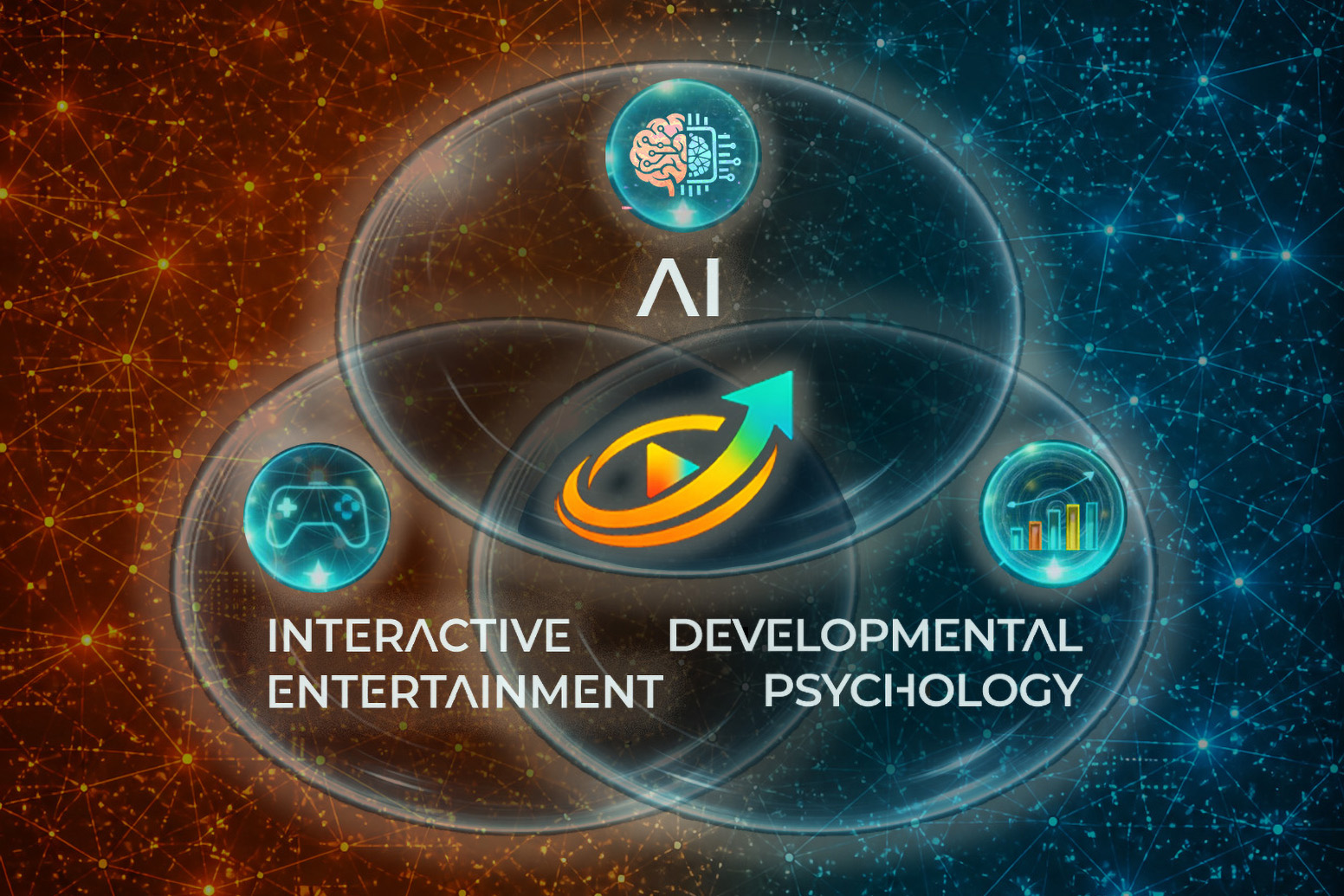
When AI's capability to read, adapt, guide, and generate is combined with interactive entertainment's capacity to engage, immerse, and create embodied experience - and when both are directed by a comprehensive developmental framework - something becomes possible that has never existed before.
An experience that knows you well enough to grow you. That reads your actual state - not a demographic profile, not a behavioral archetype, but you,
right now, in this moment, and your patterns over time. That adapts not to keep you comfortable, but to offer exactly the stretch that serves your
next edge of development.
That generates narrative, challenge, and reflection that fits your life, your patterns, your potential.
That does all of this invisibly, inside an experience you'd choose anyway because it is genuinely good.
Not an app. Not a course. Not a game in the traditional sense. Something new - a category that doesn't have a name yet because it hasn't been built yet.
The engine exists. The medium exists. The map exists.In 2026, for the first time, all three are ready at the same time.

Site Architecture
Home



Gateway Pages









Research Trajectory · Deep Dive





Communication · Many Channels







contact
On the same wavelength?
If this research resonates with you - whether you work in AI, Interactive Entertainment, or Developmental Psychology, or simply want to connect as a kindred spirit - let's talk.



Artificial Intelligence (AI)

© 2026 Press Play to Grow! All rights reserved.